In SAP systems the number of users, roles and authorizations keeps growing over time. New users are added. New roles are created. New authorizations are added to existing roles. People’s duties change. Temporary access can become permanent.
After a while a very simple question turns into quite a hard one: who currently holds which authorizations in our SAP system? And more importantly: are those authorizations still needed?
Enterprise solutions such as SAP Access Control offer comprehensive processes: access requests, risk analysis, role management, SoD controls and reporting. But in authorization management there is something as important as the technology.
Visibility
In an SAP system with thousands of users and roles, producing reports alone may not be enough. You need to be able to see changes continuously, understand which authorizations sit with whom, notice critical combinations, evaluate risks in time, and present all of it in a way decision makers can easily follow.
Take a single example: vendor creation or invoice payment authorizations can be granted as a business requirement. But the same authorizations sitting together on one user can create a different kind of risk.
So the question is not only “which role does this user have?”. The real question should be: “when these roles and authorizations are evaluated together, what can this user do?”
That is why three topics are becoming more important in modern authorization management.
1. Tracking
Keeping role and authorization changes continuously visible.
2. Control
Detecting critical authorization combinations and SoD risks at an early stage.
3. Visibility
Evaluating user, role, authorization and risk information at a glance through understandable reports and charts.
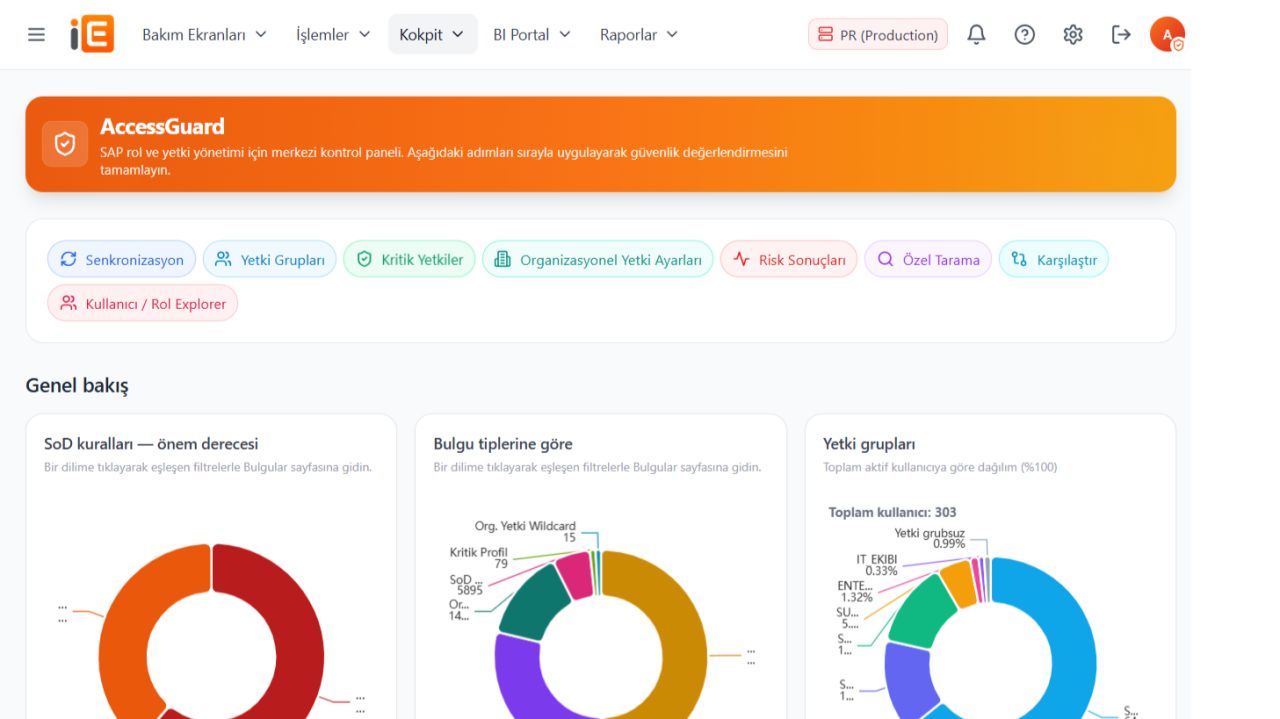
We position our AccessGuard approach on exactly this need: making SAP roles and hierarchies visible, tracking changes, building AI-assisted SoD rules, testing those rules against real users, examining critical authorization combinations, and presenting audit and compliance reports in one place.
The aim is not simply to produce more reports. It is to be able to see whether SAP authorizations really are under control. Because in authorization management the biggest risk is sometimes not that a wrong authorization was granted; it is that what a granted authorization has turned into over time can no longer be seen.