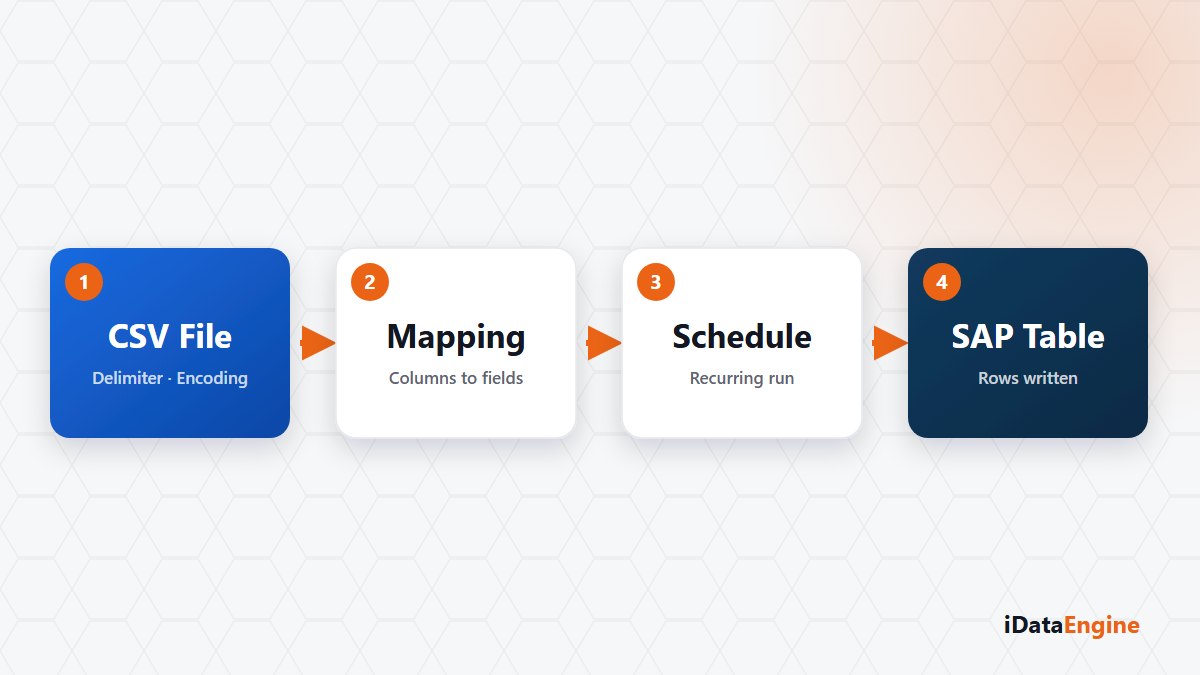
The supplier file arrives at 07:30 every morning. So let the flow run at 07:45 every morning — that is usually how the sentence gets built in the meeting.
The sentence is reasonable, and it treats two different paths as one. On the write-into-SAP side, a file-sourced transfer and a database-sourced transfer do not share a trigger, and not knowing that leaves a quiet hole in the project plan.
The file path is user-triggered; the SQL path is scheduled
The file-based transfer is user-triggered. Someone uploads a CSV or TXT file from the project screen, it is read with the encoding, delimiter and header settings, the mapping is applied, and rows go to SAP in packages. The upload returns a log id, and progress and result are followed in the pipeline records. This path is not scheduled; a person has to upload the file.
The transfer sourced from an external SQL database can be scheduled through the job framework. Because the source is a database table or an activated query, the flow runs without human involvement.
The 32 MB limit and formats other than CSV/TXT
Two limits belong on the file path. The upload ceiling is 32 MB, and reading is done by a CSV/TXT parser; Excel files are not part of this path. File content is held in server memory during processing, so splitting large files belongs in the plan from the start.
Those limits usually cause less trouble than people expect. What does cause trouble is format variability: files whose column order shifts, and that sometimes carry a header row and sometimes do not.
A staging table is the real precondition for automation
If you genuinely want an unattended nightly flow, the file has to land in a database table first. The common solution: the organisation’s existing file intake process writes the file into a staging table, and the project that writes to SAP reads from that table. The schedule is then built on the SQL-sourced flow.
Not every process wants automation, though. In some flows the person uploading the file is also the person checking its contents, and removing that check is not a gain but a transfer of risk. Deliberately keeping the upload step with a human is a valid decision.
Three questions settle the choice:
- Does the file always arrive in the same format? Variable column layouts are what breaks automated flows most often.
- Is an approval step needed before the load? If so, the user-triggered path is a control rather than a limitation.
- Who watches for errors? A scheduled flow with no named owner for monitoring can turn into silently missing data.
The target-side rules stay the same on both paths: key-based updates make a rerun safe, a failed package leaves earlier packages in SAP, and audit fields tell you when a row arrived.
It is not worth opening the automation debate before those three questions are answered. Write the answers down, send them over, and let us decide together which path fits your process owner — and design the staging table in the same session if that is the way it goes.